From World Cup 2026 to LA28: Solar Light Towers as Long-Term Security Infrastructure for Los AngelesPosted by Stephen Shickadance in Most Popular. Industry News. Inspiring Projects. Applications of Solar Lighting.The Two-Billion-Dollar Moment That Changed LA’s Infrastructure Playbook The 2026 FIFA World Cup is not a test run for the Olympics — it is a dress rehearsal for the largest security mobilization in Los Angeles history. SoFi Stadium will host eight World Cup matches and, two years later, the Olympic Opening and Closing Ceremonies along with the largest swimming venue ever built for the Games. By the time the Paralympic flame is extinguished in August 2028, the Los Angeles region will have hosted over 800 events across 80 venues, with an estimated 12 to 15 million ticketed spectators flooding the city.
But beneath the spectacle lies a quieter story — one about light poles, copper wire, and the infrastructure decisions that will determine whether LA’s sporting legacy is a triumph or a cautionary tale. LA28 has pledged a “no-build” Olympics, committing to reuse existing venues and pre-planned infrastructure rather than constructing permanent new facilities. The organizing committee will purchase 100% renewable electricity for venues and host a transit-first Games. These are bold sustainability goals — but they expose a critical vulnerability: the city’s existing lighting infrastructure is failing. Los Angeles operates more than 220,000 street lights. An estimated 60,000 are eligible for solar conversion. There are currently 32,000 outstanding street light service requests, and repairs caused by copper wire theft cost at least four times more than standard maintenance. Copper theft incidents have increased 1,200% in the last decade. The city’s funding for street light infrastructure has remained unchanged since 1996. The World Cup is revealing these cracks. The Olympics will expose them further. Solar light towers offer a solution that serves both events — and the city — for decades to come. The Testing Ground: Why the World Cup Matters for LA28 Security PlanningThe World Cup is not the Olympics — but it is close enough to matter. The tournament will bring eight matches to SoFi Stadium, drawing massive crowds and forcing every layer of LA’s infrastructure to perform under pressure. Transit networks, security perimeters, traffic management, and emergency response systems will be tested in real time. LA28 organizers have explicitly studied the World Cup as an Olympic test case. The lessons learned — where crowds accumulate, where lighting fails, where security gaps appear — will inform planning for the 2028 Games. For property owners and infrastructure managers, the message is direct: fix lighting vulnerabilities now, before the Olympics multiply the stakes. The LA28 Games have been designated a National Special Security Event (NSSE), and the federal government has committed $1 billion for security purposes. The City of Los Angeles has committed $270 million for cost overruns, and the State of California has committed another $270 million. However, LA28’s $7.15 billion Games budget does not include security costs, raising concerns about how “enhanced resources” — including lighting — will be funded and reimbursed. City officials are negotiating an Enhanced City Resources Master Agreement (ECRMA) to ensure the city is fully reimbursed for Games-related services. Preliminary estimates indicate security costs alone may exceed $1 billion. Councilwoman Monica Rodriguez has introduced a motion to enshrine a “Zero-Cost Principle” for the Games, requiring LA28 to reimburse the city for all enhanced resource costs — including lighting — before any surplus funds are declared. This financial uncertainty creates a powerful incentive for property owners to act independently. Waiting for reimbursement agreements may leave infrastructure unfunded until it is too late. Solar lighting, with its 30% federal ITC tax credit, allows property owners to upgrade security lighting now — on their own timeline — and lock in long-term savings before the Olympic crowds arrive.
The Infrastructure Reality: 32,000 Broken Lights and CountingThe numbers from Los Angeles’ street lighting crisis are staggering:
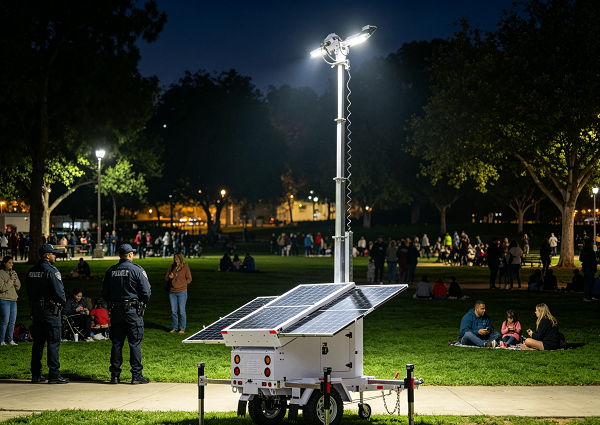
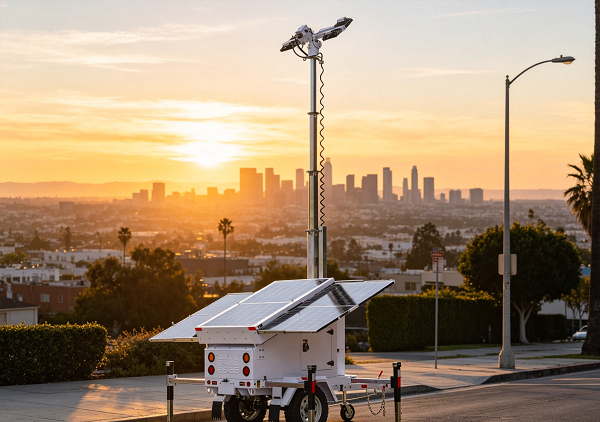
Mayor Karen Bass launched the Street Lights Initiative in March 2026, an historic program that will repair and replace up to 60,000 street lights over two years using solar technology. The City Council simultaneously approved a $65 million “Solar Surge” investment to accelerate conversions. Hundreds of solar street lights have already been installed in neighborhoods like Watts, Historic Filipinotown, Granada Hills, and North Hollywood. Councilmember Katy Yaroslavsky, chair of the Budget and Finance Committee, framed the urgency directly: “The number one thing I hear from constituents, police officers, and business owners is, ‘when are the lights going to come back on.’ Angelenos expect reliable city services, and right now the City is falling short. This investment allows us to move faster on repairs while addressing the root cause of repeat outages. By shifting to solar, we reduce the risk of theft, improve reliability, and deliver basic services more effectively”. Councilmember Eunisses Hernandez, chair of the Public Works Committee, added: “Our constituents are tired of an expensive, futile cycle where lights go out, copper gets stolen, and repairs take months just to happen all over again. Solar lets us get ahead of that problem instead of constantly chasing it”. Mayor Bass was equally direct: “Instead of continuing to patch together antiquated street light technology, we’re using solar to make our lights more reliable, resistant to theft, and cleaner to operate”. What is true for the city’s street lights is equally true for private parking lots, warehouse perimeters, and commercial properties. If copper theft can overwhelm a municipal system with 220,000 lights, no commercial lot with grid-tied copper wiring is immune. The Solar Solution: Security Infrastructure That Pays for ItselfSolar light towers are not temporary fixes. They are permanent security assets that eliminate the vulnerabilities of grid-tied lighting while generating long-term financial returns. Here is how they align with LA28’s “no-build” sustainability mandate and the city’s zero-cost principle. 1. The Copper Theft Problem Has a Permanent SolutionGrid-tied lighting systems rely on long runs of underground copper wire. Thieves know where to find it, and they return to the same locations repeatedly because the target never changes. Each theft event leaves lots dark, security compromised, and repair budgets depleted. Solar light towers contain no underground copper. There is nothing to steal, no conduit to breach, no outage risk from theft. This immunity is the single most important security feature of solar lighting for Los Angeles properties. The city’s own Solar Street Lights Initiative is explicitly designed to combat copper theft by removing copper from lighting infrastructure entirely. Councilwoman Monica Rodriguez, who joined Mayor Bass to announce the initiative, stated: “This initiative takes meaningful action to fix thousands of our City’s broken lights and restore visibility where it’s been missing for far too long, while moving us toward more secure, solar-powered street lights that are less vulnerable to theft”. 2. Solar Aligns with LA28’s “No-Build” Sustainability MandateLA28 has committed to using existing or pre-planned infrastructure and prioritizing clean energy and transportation. Solar light towers fit this framework perfectly—they require no trenching or new construction and generate zero emissions. The LA28 Impact and Sustainability Plan specifically emphasizes “reuse across the Games’ temporary infrastructure” and “100% renewable electricity for venues”. Solar lighting delivers both: existing infrastructure is retained and upgraded, and ongoing energy consumption is eliminated. 3. Solar Lighting Provides Grid-Independent ResilienceSolar street lights equipped with integrated battery storage provide dependable illumination even during grid disruptions, strengthening the city’s resilience. This matters during emergencies, severe weather events, or the inevitable strain that the Olympics will place on LA’s electrical grid. For commercial properties near Olympic venues — hotels, parking structures, retail centers, warehouses — grid independence is not a luxury. It is a security requirement. If the grid fails during an Olympic event, solar-powered lighting keeps lots illuminated, cameras operational, and security perimeters intact. 4. The ITC Tax Credit Makes Solar an Immediate Financial WinCommercial solar lighting systems qualify for the 30% federal Investment Tax Credit (ITC) under the Inflation Reduction Act — a direct reduction in federal tax liability. For a $200,000 solar lighting installation, that is a $60,000 credit. Additional bonus credits may apply for domestic content (+10%), energy communities (+10%), and low-income communities (+10–20%), potentially reaching 50% of project costs. However, deadlines are approaching: projects must begin construction by July 4, 2026, or be completed by December 31, 2027, to qualify. This creates urgency for property owners who want to lock in federal incentives before they expire. For Los Angeles property owners, the ITC is a powerful tool to accelerate security upgrades while reducing net costs. The same calculus applies to residential developments: homeowners associations and property managers near Olympic venues can use the ITC to fund solar lighting upgrades that lower HOA electricity bills, improve safety, and support the region’s clean energy transition. 5. A 10-Year ROI That Outperforms Grid-Tied LightingThe long-term financial case for solar is well documented. A comprehensive case study comparing solar LED parking lot lights to grid-powered LED fixtures found that the solar system delivered a total cost of ownership 50% lower than the grid-powered alternative over 10 years, even after factoring in battery replacement. The same study found that 30 solar fixtures saved $107,208 in electricity costs over 10 years compared to grid-powered equivalents. Battery replacement added $18,000, but the net savings still exceeded $89,000 — without factoring in the ITC credit, which would have reduced upfront costs further. Another independent total cost of ownership analysis from a commercial parking lot project in Massachusetts found that solar lighting saved approximately $49,943 over 10 years compared to grid lighting at $0.24/kWh. Solar landscape lighting systems consistently deliver total cost of ownership savings averaging 15–40% over 10 years, depending on installation size and local electricity rates. These savings are directly applicable to Los Angeles, where commercial electricity rates are significantly higher than the national average. Every dollar saved on lighting is a dollar that can be reinvested in security personnel, cameras, or other Olympic-readiness measures. From Temporary to Permanent: The Asset Lifecycle of Solar Light TowersOne of the most misunderstood aspects of solar lighting is its lifespan. Solar light towers are not disposable event rentals. They are engineered assets designed for 10–15 years of service, with battery replacements required only once or twice during that period. This makes them ideal for LA’s sporting event timeline:
This asset lifecycle — deploy for World Cup, maintain through Super Bowl, rely on for Olympics, then retain as permanent infrastructure — delivers value far beyond the initial investment. Property owners who purchase solar towers are not buying event lighting. They are acquiring a decade of security lighting, paid for once, with zero ongoing electricity costs, and fully eligible for the 30% ITC credit. The alternative — renting diesel generators or short-term solar units — produces no long-term asset value. Rental payments disappear into operating expenses, and when the events end, the property is left with nothing but dark poles and a depleted budget. Councilmember Hernandez captured the long-term perspective: “Our ecosystem of public safety starts with delivering the basics — like well-lit streets — and our communities deserve fiscally responsible, smart, sustainable and innovative infrastructure that works the first time and keeps working”. A Roadmap for Property Owners: Acting Before the Olympic Crowds ArriveThe World Cup is happening now. The Olympics are two years away. Property owners near Olympic venues — including hotels near LAX, parking structures in Inglewood, commercial lots in Downtown LA, and warehouse districts throughout the region — should take the following steps: 1. Conduct a Lighting Audit 2. Request a Photometric Plan 3. Lock in the ITC Before July 4, 2026 4. Deploy for the World Cup, Retain for the Olympics 5. Integrate with Existing Security Systems The Bottom Line: A Once-in-a-Generation Infrastructure OpportunityLos Angeles is about to host the two largest sporting events in the world — the World Cup and the Olympics — in rapid succession. The city’s lighting infrastructure is already buckling under the weight of copper theft, deferred maintenance, and a funding model frozen since 1996. Mayor Bass’s 60,000-unit solar initiative is a historic response, but it focuses on public streets, not private property. Commercial property owners have the same exposure — and the same opportunity. Solar light towers eliminate copper theft risk, provide grid-independent illumination, reduce operating costs, and qualify for the 30% federal ITC tax credit. They can be deployed in time for the World Cup, maintained through the Super Bowl, relied upon for the Olympics, and retained as permanent security assets for the decade that follows. The World Cup is the test. The Olympics are the deadline. Act now. Request a free solar lighting feasibility review for your property. Lock in your ITC eligibility before the July 4, 2026 deadline. References
Most Popular
Industry News
Inspiring Projects
Applications of Solar Lighting
|
ArchivesNo Archives Categories
Want More Info? |
LATEST NEWS & ARTICLES